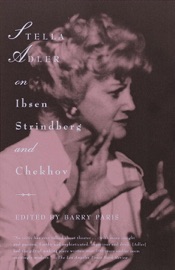
In her long-awaited book, the legendary acting teacher Stella Adler gives us her extraordinary insights into the work of Henrik Ibsen (âThe creation of the modern theater took a genius like Ibsen . . . Miller and Odets, Inge and OâNeill, Williams and Shaw, swallowed the whole of himâ), August Strindberg (âHe understood and predicted the forces that would break in our livesâ), and Anton Chekhov (âChekhov doesnât want a play, he wants what happened in life. In life, people donât usually kill each other. They talkâ).
Through the plays of these masters, Adler discusses the arts of playwriting and script interpretation (âThere are two aspects of the theater. One belongs to the author and the other to the actor. The actor thinks it all belongs to the author . . . The curtain goes up and all he knows are the lines . . . It is not enough . . . Script interpretation is your professionâ).
She looks into aspects of society and class, and into our cultural past, as well as the evolution of the modern spirit (âThe actor learns from Ibsen what is modern in the modern theater. There are no villains, no heroes. Ibsen understands, more than anything, there is more than one truthâ).
Stella Adlerâdaughter of Jacob Adler, who was universally acknowledged to be the greatest actor of the Yiddish theater, and herself a disciple of Stanislavskyâexamines the role of the actor and brings to life the plays from which all modern theater derives: Ibsenâs Hedda Gabler, The Master Builder, An Enemy of the People, and A Dollâs House; Strindbergâs Miss Julie and The Father; Chekhovâs The Seagull, Uncle Vanya, The Cherry Orchard, and Three Sisters (âMasha is the sister who is the mystery. You cannot reach her. You cannot reach the artist. There is no logical way. Keep her in a special pocket of feelings that are complex and differentâ).
Adler discusses the ideas behind these plays and explores the world of the playwrights and the historyâboth familial and culturalâthat informed their work. She illumines not only the dramatic essence of each play but its subtext as well, continually asking questions that deepen oneâs understanding of the work and of the human spirit.
Adlerâs book, brilliantly edited by Barry Paris, puts her famous lectures into print for the first time.
Stella Adler on America's Master Playwrights - Stella Adler & Barry Paris
In her long-awaited book, the legendary acting teacher Stella Adler gives us her extraordinary insights into the work of Henrik Ibsen (âThe creation of the modern theater took a genius like Ibsen . . . Miller and Odets, Inge and OâNeill, Williams and Shaw, swallowed the whole of himâ), August Strindberg (âHe understood and predicted the forces that would break in our livesâ), and Anton Chekhov (âChekhov doesnât want a play, he wants what happened in life. In life, people donât usually kill each other. They talkâ).
Through the plays of these masters, Adler discusses the arts of playwriting and script interpretation (âThere are two aspects of the theater. One belongs to the author and the other to the actor. The actor thinks it all belongs to the author . . . The curtain goes up and all he knows are the lines . . . It is not enough . . . Script interpretation is your professionâ).
She looks into aspects of society and class, and into our cultural past, as well as the evolution of the modern spirit (âThe actor learns from Ibsen what is modern in the modern theater. There are no villains, no heroes. Ibsen understands, more than anything, there is more than one truthâ).
Stella Adlerâdaughter of Jacob Adler, who was universally acknowledged to be the greatest actor of the Yiddish theater, and herself a disciple of Stanislavskyâexamines the role of the actor and brings to life the plays from which all modern theater derives: Ibsenâs Hedda Gabler, The Master Builder, An Enemy of the People, and A Dollâs House; Strindbergâs Miss Julie and The Father; Chekhovâs The Seagull, Uncle Vanya, The Cherry Orchard, and Three Sisters (âMasha is the sister who is the mystery. You cannot reach her. You cannot reach the artist. There is no logical way. Keep her in a special pocket of feelings that are complex and differentâ).
Adler discusses the ideas behind these plays and explores the world of the playwrights and the historyâboth familial and culturalâthat informed their work. She illumines not only the dramatic essence of each play but its subtext as well, continually asking questions that deepen oneâs understanding of the work and of the human spirit.
Adlerâs book, brilliantly edited by Barry Paris, puts her famous lectures into print for the first time.